AI² · Pattern Over Noise

The AI² Library

Governance for the Age of Advanced Intelligence

For the builders, strategists, executives, and fiduciaries who must govern systems that already move faster than regulators, oversight, or human control. Hard-won frameworks forged where failure was never an option.

Four decades of fault-tolerant engineering since 1986 · 38+ patents across the career · Twelve USPTO provisional filings on the AI² architecture

CAN DO MAY DO DETERMINISTIC GATE FOUR-STATE TOPOLOGY PERMIT DENY HOLD FRACTURE

The Anchor · Start Here

Flagship · The Canonical Argument

The Authorization Gap™

Why capability is not authorization

AI can act. Nothing governs what it is allowed to do. That is the gap. This is the full architecture behind the AI² thesis — documented, patented, and verified in simulation: the Quadzistor™, PCR™, and the hardware-enforced permission gates that make authorized action a physical constraint, not a policy hope.

The definitive statement of the problem AI² was built to solve, written for the executives, boards, and fiduciaries who will answer for it.

Read the Book →
PERMIT DENY HOLD FRACTURE

Quadzistor™ · Four-State Authorization Lattice
Hardware root-of-trust · PCR™ enforcement

Why This Is Serious Work

12 USPTO
Filings

The Authorization Gap™ architecture — Quadzistor™, PCR™, and hardware-enforced permission gates — protected across twelve provisional patent filings.

Verified in
Silicon

A reference implementation in VHDL, run in simulation — including a real defect found and corrected in verification. Engineering, not analogy.

Red Team
Public Challenge

From October 1, 2026, security researchers are invited to break the ChronaGate™ hardware authorization boundary. One victory condition: cause an action the frozen policy denies to execute through the protected boundary. Proof by adversary, in public.

Author's record: four decades of fault-tolerant systems engineering since 1986, across nuclear, aerospace, and industrial environments on six continents · 38+ patents granted over the full career, in and beyond this field.

The Lattice · How to Read the Work

The Recommended Path

These are not eighteen separate books. They are one argument, built in sequence — the problem, the proof, the architecture, the doctrine, the economics, and the ground truth. Start at the top and the rest resolves into a single system.

Start Here · The Bundle

New to the work? Take the guided path.

Six books, one argument, in the order that makes them resolve into a single system. Begin with the flagship, then follow the sequence. Download the one-page map to keep it close.

1

The Problem, Named

The Authorization Gap™

AI can act. Nothing governs what it is allowed to do. The canonical statement of the problem and the architecture that closes it — the Quadzistor™, PCR™, and hardware-enforced permission gates.

Read on Amazon →
2

The Proof

Deterministic Governance of AI

Where the thesis becomes engineering. A century of safety-critical practice — nuclear, aviation, chemical, cyber — reduced to one rule: wrap the capable-but-fallible actor in an independent, fail-safe, provable layer. Complete with reference architecture, VHDL, simulation traces, and a real defect caught in verification.

Read on Amazon →
3

The Stakes & The Specs

Asymmetric Warfare in the Age of AI

Why the only winning move is not to play. Civilizational survival by governance design, with the full PCR™ and Quadzistor™ specifications in the appendices — where the theory becomes engineering.

Read on Amazon →
4

The Doctrine

The Governance of Advanced Technologies & Systems

Most failures don't begin with malfunction — they begin with success. Why systems that deploy on time with green dashboards still lose control, and what survivors do differently.

Read on Amazon →
5

The Economics

Context Capitalism™

When AI makes cognitive labor abundant, value shifts irreversibly from production to contextualization — and the only scarcity left that matters is coherent human consciousness. Where the world goes next.

Read on Amazon →
6

The Ground Truth

The Workforce Shock

Your title hasn't changed. Your reviews are strong. Your role may already be gone. What the transition looks like from inside a career — the five signals and the repositioning playbook.

Read on Amazon →

Where This Goes Next

The books are the doctrine.
The gate is the product.

The library explains why permission has to be enforced below the layer that acts. ChronaGate™ is the hardware that does it, and TARTARUS™ is the containment around it. If you came here from an argument about whether AI can be controlled, this is the part that is built.

The Governance Library · On Amazon

The Complete Canon

The six above are the argument. What follows is the complete record — the same thesis carried into economics, defense, careers, and the consumer edition, plus the engineering history it came from. Available in paperback, hardcover, and Kindle. If you are here to evaluate the doctrine rather than collect it, read the path and stop.

01

The Authorization Gap™

Why Capability Is Not Authorization

The canonical statement of the problem and the architecture that closes it — the Quadzistor™, PCR™, and hardware-enforced permission gates that make authorized action a physical constraint, not a policy hope.

02
New · The Engineering Case

Deterministic Governance of AI

What a Century of Safety Engineering Already Knew

Trust is not a safety function. Every mature safety-critical field — nuclear, aviation, chemical, cyber — converged on the same answer: wrap the capable-but-fallible actor in an independent, fail-safe, provable layer that can say no. The full engineering case for the Authorization Gap™ — reference architecture, VHDL implementation, simulation traces, a threat model, functional-safety mapping, and a real defect found and corrected in verification. The book that moves the conversation from philosophy to engineering.

03

AI Governance

What Every CEO and Board Member Needs to Know Before the Regulator Arrives

Your AI is drifting. Your liability is growing. Your governance is theater. Why AI governance differs from software governance, and what courts and regulators actually ask.

04

The CEO's Guide to AI

Second Edition · How to Think, Compete, and Lead When the System Can Act

The first edition was written about a machine that recommended. The second is about one that acts. Interpretation is still the CEO’s work — but interpretation without authorization is commentary. Carries the Authorization Gap™ in board language, thirteen questions your directors should be asking, and a hundred-day plan that begins by finding out what is already running in your name.

05

AI Risk Assessment and Mitigation

The Executive Reference

Organizations won't fail because AI doesn't work — they'll fail because it works at scale without governance. Frameworks, checklists, and decision tools for real-world fiduciary oversight. Not a warning. A map.

06

The Governance of Advanced Technologies & Systems

The Art of War for Modern Times

Most failures in advanced technology don't begin with malfunction — they begin with success. Why systems that deploy on time with green dashboards still lose control, and what survivors do differently.

07

Asymmetric Warfare in the Age of AI

The Only Winning Move Is Not To Play

The weapons are already choosing. Civilizational survival by governance design — hardware-enforced execution authority, architectural circuit-breakers, incorruptible accountability records. Appendices include full PCR™ and Quadzistor™ specs.

08

Context Capitalism™

The Reichwein Theory of Context Capitalism

When AI makes cognitive labor abundant, value shifts irreversibly from production to contextualization — and the only scarcity that matters is coherent human consciousness. The clearest map of the post-labor epoch.

09

The Great AI Transition Economy

How AI Will Reshape Work, Wealth, and the Future of Policy

Roughly 30 million US roles restructured by 2040 against about 11 million created — the Barbell Economy, the vanishing middle, and a Transition Bridge costed in three cases, not one. Every load-bearing number carries a methodology appendix and a dated condition that would prove it wrong.

10

The Workforce Shock

The Silent Erasure of White-Collar Work

Your title hasn't changed. Your reviews are strong. Your role may already be gone. A field guide to the silent restructuring already underway — the five signals, the three tiers, and the repositioning playbook to move before the window closes.

11

Digital Darwinism

Master AI, Multiply Your Capability, Conquer Your Competition

You are being optimized by systems that know your vulnerabilities better than you do. The field manual for the Intelligence Revolution — algorithmic literacy, capability multiplication, and family protection protocols.

12

The People's Guide to AI

How to Use AI to Improve Your Life

Written not for engineers but for parents, professionals, students, and citizens who refuse to be manipulated. Flip the script on the algorithms making thousands of invisible decisions for you — protect your family, secure your future, reclaim control.

13

Doctrine After Disaster

Automated Control Systems: The Past, Present and Future

Every safety doctrine now taken for granted was written after something failed. The history of automated control read as a single lesson — that permission gets enforced below the acting layer only after the cost of not doing it has been paid in public.

14

Symbiosis

The Probabilistic and Deterministic Governance Solution for AI

Policy without enforcement is a wish. Enforcement without policy is a cage. Probabilistic governance runs on humans; deterministic governance runs on physics. Neither half is optional, and this is the book that puts them in the same control system.

15

Autonomous Intelligence

When Machines Stop Obeying and Start Choosing

The earliest book in the library and the one that named the problem before the vocabulary existed. What changes at the moment a system stops executing instructions and starts selecting its own — and why that moment is an engineering event, not a philosophical one.

16

From Vacuum Tubes to AI

A Human Journey

Four decades at the controls, told as one continuous line — from tubes and ladder logic to systems that act on their own authority. The memoir behind the doctrine, and the reason its author does not find any of this abstract.

17

The Algorithmic Decoder

How Algorithms, Feeds, and AI Are Built to Move You — and How to Stay the One Deciding

The consumer edition of the same argument. Something is choosing what you see, and it is optimizing for an objective that was never shown to you. How the machinery works and how to remain the one who decides.

18

X Unlocked

How to Build a Network That Thinks Without You

A short doctrine on distributed systems that happen to be made of people. Build a lattice rather than an audience, protect your voice with a fidelity check, and measure the whole thing by the Test of Absence — what keeps moving when you stop posting.

Direct from the Author

Get It Direct

Select titles straight from the author through Gumroad — no store, no middleman, instant delivery to any device.

01
The Authorization Gap™ — Author's Manuscript
Why capability is not authorization, direct from the author. The full architecture for closing the gap between capability and authorized action.
→
02
AI Governance
What every CEO and board member needs to know before the regulator arrives. Why AI governance is not software governance.
→
03
Asymmetric Warfare in the Age of AI
The only winning move is not to play. Civilizational survival by governance design. Includes full PCR™ and Quadzistor™ specs.
→
04
The Governance of Advanced Technologies & Systems — Condensed
The condensed reference for executives and fiduciaries. Why power, not performance, determines who survives the next cycle.
→
05
Context Capitalism™
The Reichwein Theory. When cognitive labor is abundant, the only remaining scarcity that matters is coherent human consciousness.
→
06
The Workforce Shock
The silent erasure of white-collar work. The displacement of cognitive labor is not coming — it has already happened.
→
07
Digital Darwinism — The Condensed Field Guide
Master AI, multiply your capability, conquer your competition. The condensed field manual for the Intelligence Revolution.
→
08
The People's Guide to AI
Not written for engineers. Written for everyone. A plain-language framework for what AI is, what it isn't, and what it means for your family.
→
09
Autonomous Intelligence — Author's Manuscript
The next generation of AI and the rebirth of humanity. The original manuscript, direct from the author, on what comes after the tools start deciding.
→

The University of Success™ · The School Behind the Frameworks

Live Cohort · Limited Seats

Learn the method in a live global cohort

Everything in Pro, plus live sessions, direct instructor feedback, and a seat at the table with people applying the same frameworks in the field. The pattern-recognition discipline behind the entire library — taught, not just read.

Join a Cohort →

Est. 2026 · Nashville · Teaching Everywhere

The University of Success™

We don't teach you what to think. We teach you how.

7Disciplines
48Courses
10Principles
195+Countries
∞Lifetime Access

Pattern Recognition · Systems Thinking · Probabilistic Reasoning · Emotional Intelligence · Strategic Communication · Asymmetric Decision-Making · Legacy & Stewardship

Free Access
Start Here

Intro to all seven disciplines, the ten principles, Pattern Recognition 101, and the global community. No card, no gatekeeping.

Enroll Free →
Pro
Most Chosen

Every course, every discipline, every deployment exercise — plus new courses as they are added.

Go Pro →
Cohort
Live & Accountable

Everything in Pro, plus live global cohort sessions, direct instructor feedback, and a limited seat at the table.

Join a Cohort →
Certified
Mastery

Everything in Cohort, plus full portfolio review and a LinkedIn credential — proof of demonstrated capability, not attendance.

Get Certified →

The old university sold you a credential. This one gives you a weapon.

Enter the University →

The Signal · Canonical White Papers & Briefs

The Living Record

The frameworks don't stand still. The white papers and the Global Systemic Intelligence Brief apply the Authorization Gap™ to the crises as they break — energy, compute, and geopolitics — read in real time and published direct at ai2signal.com.

The Author

David P. Reichwein
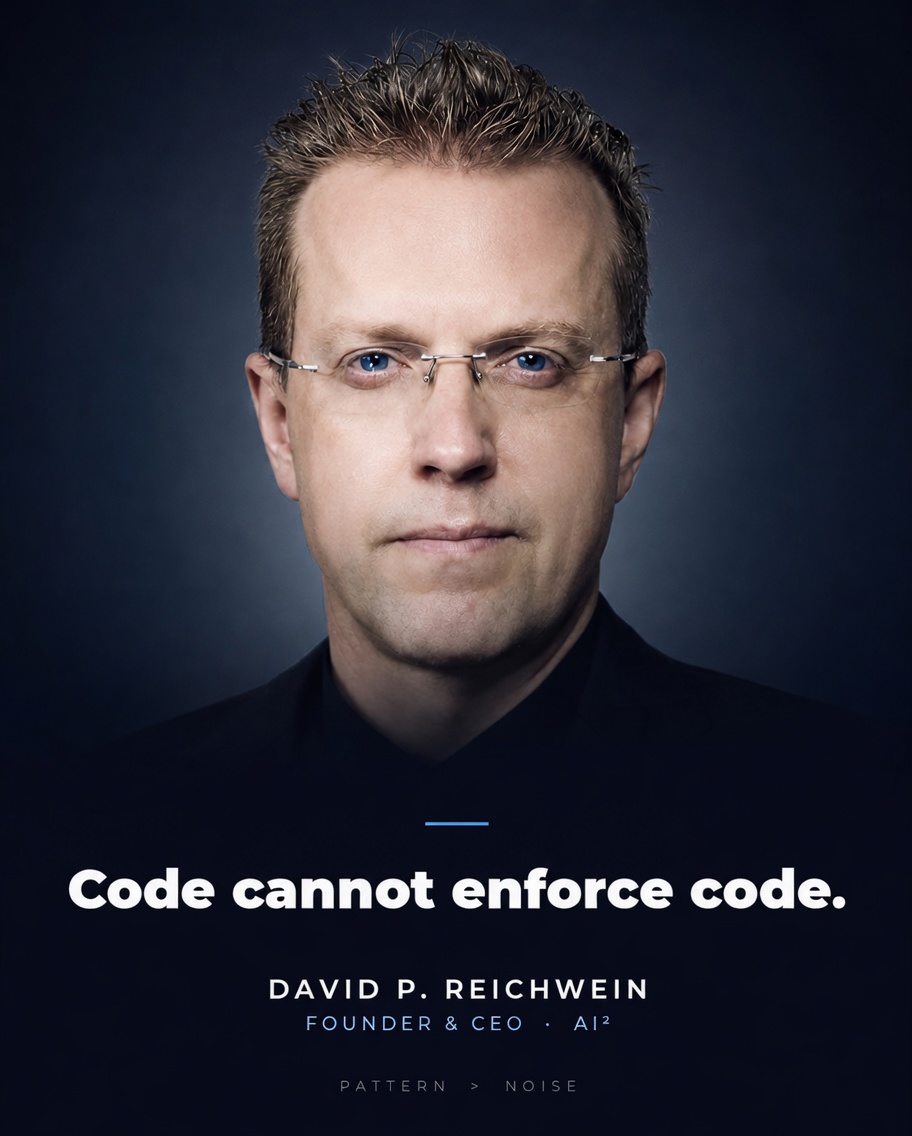
David P. Reichwein, Founder and CEO of AI² (Asymmetric Intelligence & Innovation) — inventor of the Authorization Gap™, Quadzistor™, and PCR™ hardware-enforced AI governance architecture.

In high-consequence systems, the failure is never the malfunction. It is the gap between what a system can do and what it is authorized to do.

David P. Reichwein is the founder and CEO of AI² (Asymmetric Intelligence & Innovation), based in Nashville, Tennessee. Across four decades of fault-tolerant systems engineering since 1986 — nuclear, aerospace, and industrial environments on six continents — he learned that discipline the hard way, refining it across a career that has produced 38+ patents — most of them in fields that have nothing to do with artificial intelligence — before turning the discipline on AI.

That principle became the Authorization Gap™, and the architecture built to close it — the Quadzistor™ and PCR™, protected by twelve USPTO provisional filings. The distributed topology at its core was first glimpsed in the pattern-perception of his nonverbal son, William. Having lived through Argentina's 2002 collapse, Reichwein reads systemic fragility the way most people read headlines.

AI² exists for one purpose: to make authorized action a physical constraint before autonomous systems make the next irreversible decision. The work is not about him — it is about what is best for humanity, and for every intelligence that follows.

4 decadesFault-Tolerant Engineering
38+Patents · Full Career
12Provisionals · AI² Architecture
6Continents